
Get Your FREE Case Review
 5.0 Rating | Highly Rated & Trusted for Over 50 Years
You don’t have to face this fight alone. At Edwards & Patterson, our team brings over 50 years of experience in securing full and fair compensation for injured victims like yourself.
An attorney experienced in personal injury can help determine if you are entitled to receive compensation for injuries sustained by the careless actions of a garbage truck driver, a private waste hauling company, as well as a city employee or maintenance personnel. The first step is determining who was operating the vehicle. The next steps include preserving route and camera records so that they will be available at a later date. Additionally, the Tulsa garbage truck accident attorneys can advise you with regard to what filing requirements will apply based upon the nature of the parties involved. This matter is important due to the fact that filing requirements differ significantly between an ordinary claim filed against a private company versus a claim made against the City of Tulsa (or other governmental entities).
Garbage trucks typically travel along a regular daily collection route traveling on residential streets, in alleys, to driveways, and around business locations. All types of motorists, including drivers of automobiles, buses, vans, and pick-ups; all classes of motorcyclists, including sport bike operators; passengers; bicyclists; and pedestrian walkers may file a claim when they are injured by careless action of someone else.

Contact us today for your free & confidential case review. Our team will help you get the compensation that you deserve.
Claims are typically made when you can demonstrate that the person had a duty of care to avoid causing your harm; the person violated this duty in some way; and the violation resulted in measurable damage (losses) to you. The investigation should be able to identify the type of hazard which was created by either a driver’s unsafe behavior, faulty equipment, or unsafe operation of the vehicle; and show how this hazard contributed to the accident.
Garbage trucks make multiple stops daily, go into tight spaces, pass close to pedestrians and parked cars, and frequently back up while workers transfer material between the truck and curb. Claims could result from hazardous backing practices, failing to yield to pedestrians, distracted driving, speeding too fast for conditions, failure to secure the rollaway after dumping, lack of maintenance of safe operating equipment, or misuse of garbage collection equipment.
There is an Oklahoma statute that relates specifically to backing accidents. Generally, you cannot back up on a public street or highway farther than necessary, which would allow the driver to safely cross over into the correct travel lane from where he has stopped. The driver must also check to ensure the maneuver can be made without endangering traffic. A ticket may help establish liability, but ultimately liability will depend upon all the information gathered.
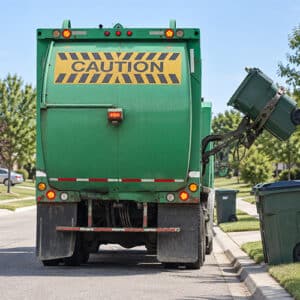 Backing into residential areas has many possible dangers for the driver of a collection truck. These include backing around people (such as children at play), pets, bicycles, etc., and possibly backing over pedestrians. In addition, there will always be a hazard in traveling through a neighborhood with limited visibility. No camera system or other warning device can take the place of confirmation by the driver that it is safe to back up. Therefore, investigators should find out how much distance the vehicle was able to travel while backing up; who, if anybody, was acting as an observer (spotter) to alert him to potential hazards; and exactly what he was able to see.
Home security systems, business surveillance cameras, dashboard-mounted cameras, and other cameras on a truck may have captured all of this action. Therefore, these should be located prior to recording being erased.
The driver of the garbage truck will frequently move back and forth in traffic, along the curb, in alleys, into driveways, and at designated collection sites. The potential for a collision occurs as a result of the driver pulling out from the side of the truck, turning from one traffic lane to another, swinging around pedestrians, cyclists, etc., who are operating in close proximity to the truck.
To assess whether a particular action by the driver is reasonable and safe, the following factors must be considered; (1) Route sequence, (2) Cart placement on the truck, (3) Time of day that collections occur, (4) Traffic signals controlling access to collection routes, (5) Crew positioning during collection operations, (6) Speed of the vehicle, and (7) Sight lines available to the drivers.
Garbage trucks combine heavy vehicles with compactors, lifting arms, hydraulic systems, alarm systems, and video camera systems. If a malfunction of any component causes a truck to roll downhill uncontrolled or fail to stop quickly enough, then it could create a hazardous situation regardless of whether there was a physical impact on a roadway. Likewise, the failure of any of the warning devices such as horns, lights, etc., or the loss of visibility through windows or mirrors can create a hazardous situation. Additionally, defects in collection equipment can cause injuries to people even though they do not involve collisions with other vehicles on the roadways.
If equipment malfunctions are suspected to be involved in a collision, a prompt inspection of the truck and all defective components, prior to any repairs being made, may help preserve important evidence. The documentation associated with the truck’s maintenance history may include information related to past reporting of equipment problems, including defect reports, service requests, parts used for repairs, and the results of inspections conducted each day prior to use.
Contact us today for your free & confidential case review. Our team will help you get the compensation that you deserve.
Due to the unique way that Tulsa provides services at the local level, it is vital to consider the roles that ownership and operation play. According to the City, the Public Works Department has oversight responsibility over refuse and recycling service as provided by the Tulsa Authority for the Recovery of Energy.
Budget documents prepared by the City additionally state that private contractors collect refuse and recyclables on an ongoing basis; however, city employees are responsible for handling large bulk items and cleaning up neighborhoods. Therefore, a city-operated truck performing city business should not automatically be assumed to be a city-owned vehicle.
If a governmental employee was acting within the scope of their employment at the time they were involved in a collision, then the Governmental Tort Claims Act will govern how you pursue your claim. This means that the proper defendant, who must receive timely written notice of your intent to file a claim against the city/county/state, the statute of limitations (deadline) for filing the claim, and potential defenses available to the city/county/state will all differ significantly from those found in a typical civil lawsuit.
Just because a private hauler has a contractual relationship with the city does NOT automatically mean that the private hauler’s drivers are now city employees. Evidence proving whether a driver is considered a “city” employee may include evidence of contracts entered into with the city, payroll documentation provided by both parties to show what portion of compensation received was from each party, documentation showing how vehicle registration and insurance coverage are maintained, the specific routes assigned to the driver by the city and/or the private hauler, and evidence of control exercised over the driver’s day-to-day activities.
In addition to the motor carrier and/or private hauler, there may be other parties who have been negligent as well. For example, if a third-party repair shop performed substandard repairs on equipment that resulted in a subsequent failure causing injuries/damages, then they could potentially be sued. Similarly, manufacturers/sellers of defective components may also be defendants in an action brought to recover losses resulting from a collision. Any party seeking damages from these third parties would need physical evidence and documentary proof to support their respective claims.
There are many types of records in garbage truck cases beyond what is included within the Collision Report. Helpful evidence can come from:
The city of Tulsa has a public records policy to allow for access to Tulsa Police Department records and other qualifying public records. A public record request does not satisfy the formal notice requirements under the Governmental Tort Claims Act. It may be necessary to send a targeted preservation notice to protect against loss of private company records or video due to normal deletion.
Contact us today for your free & confidential case review. Our team will help you get the compensation that you deserve.
The economic damages that a victim may experience due to a garbage truck accident could include: emergency transportation, hospitalization and medical treatment, possible rehabilitation, potential future medical needs, lost wages, reduction in earning capacity, vehicle repair, towing and/or storage fees, and all other reasonable documentation associated with the expense. Non-economic damages can be awarded when a person experiences physical pain, mental distress (anguish), scarring/disfigurement, and other identifiable personal harms.
Title 23, Section 61.3 defines that there will be no cap on economic damage awards on claims related to bodily injury occurring on or after September 1, 2025. In general, Title 23, Section 61.3 establishes a maximum award of $500,000.00 for non-economic damages related to claims of bodily injury. There are, however, several exceptions to this limit, including permanent severe injuries, permanent mental injuries (which has its own category and a $1 million noneconomic damages cap depending on the facts), and specified misconduct. The statute specifically excludes actions filed pursuant to the Governmental Tort Claims Act or brought under Article XXIII, Section 7 of the Oklahoma Constitution. If you have any questions regarding any of the laws discussed in this article, please do not hesitate to call and ask us any time of day. No question is too small.
 Oklahoma has a statute of limitations of two (2) years to bring an action in common law negligence against a private individual or business. This limitation will not help protect the truck’s route data, camera footage, or any other physical evidence prior to destruction.
Claims against the government are treated differently than those brought against private individuals. Written Notice must generally be provided by the plaintiff to the defendant governmental body within one (1) year of occurrence. If the claim is not completely approved, it may be considered denied by operation of law. A cause of action must generally be commenced no later than 180 days thereafter. The 90-day time frame usually represents the review period for the government, rather than when the initial written notice is required.
Also, there are statutory caps on damages as well as a prohibition on punitive damage awards for actions filed against the State or any political subdivision thereof. These caps became effective on November 1, 2025. Prior to using these caps, each party will need to determine the applicable cap based upon the nature of the loss; date of accident; population classification of the county where the incident occurred; and whether the defendant was a political subdivision. Any exceptions to deadlines could potentially change the deadline to commence litigation. Therefore, it is essential to identify the owner/operator of the vehicle(s) involved as soon as possible.
A private waste hauler could claim that the city was in control of how the garbage truck traveled (its routing) and therefore responsible for its actions; conversely, the City could point out that it hired an independent contractor to operate the vehicle. A driver might testify that he or she used the backup camera and warning system as part of backing up to confirm no other vehicles were behind the truck – this would be insufficient evidence to support that the driver had actually looked at the screen or confirmed there were no obstacles on his path. In addition, one of the defenses will likely include some variation of a pedestrian entering the blind spot of the driver; a motorist attempting to pass unsafely; or a mechanical malfunction in the equipment that occurred without warning.
In Oklahoma, comparative negligence applies. Under Title 23, Sections 13 and 14, if your negligence is greater than the combined negligence of the responsible parties, recovery is barred. Otherwise, your compensation is reduced based upon the extent of your own negligence.
Insurance companies may dispute that injuries sustained from a collision are related to previous medical conditions or if a pre-existing condition accounts for the victim’s current complaints. Medical documentation and work history will often aid in resolving these disputes.
A legal attorney may be helpful in case of severe injuries; if you cannot identify the driver or vehicle owner; if there was an accident with a governmental agency involved; or if evidence will be lost before it can be documented. An attorney will determine who the driver, vehicle owner, employer, contractor, insurance carrier, and/or governmental agency is and will determine what applicable procedure to follow.
The attorney will send a preservation notice for evidence; collect all relevant information; coordinate an inspection as needed by you; document your damages and any allegations made against you regarding fault; assist with negotiations; and prepare and submit the proper notice(s) or complaint(s).
Edwards & Patterson Law offers a free and confidential case review and states that clients pay no attorney fee unless the firm obtains compensation. Call us or use our online contact form to speak with a Tulsa garbage truck accident lawyer about the collision. Every case depends on its facts, and no result is guaranteed. Clients may also be responsible for case costs and expenses, as explained in the written fee agreement. This will always be explained in our written agreement if we are able to take your case.
The use of a trash cart or the creation of a service account will not determine ownership of the garbage truck. In addition, it does not determine which entity employs the driver. While contractors are often hired in Tulsa to perform daily collections, other large items such as construction debris and bulk items are collected by city employees. Identifying the responsible party involves identifying the license plate number on the truck; route number; state registration number (for vehicles); name of contractor used; records from the city’s Department of Public Works; and employment information. Note the specific street address, date/time, direction of travel, color(s) of the vehicle, type of vehicle, and any identifiable marks on the vehicle. Any information that may assist you in determining which entity owns/operates the vehicle, including a police report, collection schedule, dispatch records, GPS tracking system data, videos of nearby witnesses, or testimony from any witnesses to the incident, may also be helpful. A traffic citation may be an important piece of evidence; however, it is not necessary to file an action against another party. There are many types of evidence that may help you establish the negligent conduct of another party regardless of whether they received a traffic citation. Examples include: video recordings, route data, vehicle records, photographs of damage, eyewitness statements, physical evidence, and documentation of policies/procedures followed by both parties.Frequently Asked Questions
Does a City-Issued Trash Cart Mean the City Is Liable?
What if the Garbage Truck Left Before I Got Its Information?
Do I Need a Traffic Citation to Bring a Claim?
 Call Now918-302-3700
 Send Text539-295-4225









Or fill in the form below with your case details and we will respond to your inquiry within 15 minutes..
"*" indicates required fields
Or fill in the form below with your case details and we will respond to your inquiry within 15 minutes..
"*" indicates required fields
"*" indicates required fields
We will review your quote request within 1-2 business days and will contact you by either phone or email, or both. In the meantime, learn more about your team!

