
Get Your FREE Case Review
 5.0 Rating | Highly Rated & Trusted for Over 50 Years
You don’t have to face this fight alone. At Edwards & Patterson, our team brings over 50 years of experience in securing full and fair compensation for injured victims like yourself.
You will likely have claims against the careless driver of a vehicle that injured you, and possibly also at least one business related to the delivery process (depending on the employment status). A Tulsa attorney who specializes in truck accidents involving delivery vehicles can establish all parties liable; protect evidence of the driver’s route, application, and data from apps used by the driver; and document all expenses associated with your medical treatment, loss of income due to injury, pain, suffering, and any additional harm resulting from this crash.
Not every delivery vehicle is a large tractor-trailer. Parcel vans, step vans, box trucks, grocery store delivery vehicles, food delivery vehicles (including those driving for restaurants), and individuals delivering packages through their own personal automobile via “app” based services may be involved in a delivery-related vehicle collision. The key issue is not what type of vehicle crashed into you, but rather whether some form of negligence occurred which resulted in the collision and/or your losses.

Contact us today for your free & confidential case review. Our team will help you get the compensation that you deserve.
There are claims that can be made by drivers, passengers, pedestrians, bicyclists, or motorcycle riders if they were injured as a result of the negligence of a delivery driver or company in failing to exercise due care. Negligence is demonstrated when a delivery driver fails to act reasonably; e.g. (a) speed through intersections between stops, (b) view his route on a GPS/Map Device while operating his vehicle, (c) back up without first inspecting his rear view mirror and blind spots, (d) pull out of a parking space/curb without properly checking his surroundings, (e) block the line of sight of other drivers/pedestrians/bicyclists/motorcycle riders and/or (f) operate a vehicle he knows has a mechanical defect that would cause it to malfunction.
In order to make a successful claim, you will need to provide evidence that the accident was caused by someone else’s negligence and demonstrate your injuries. Evidence of medical treatment related to the injury, loss of wages/income as a direct result of the injury, repair estimates for damaged property, photos of damage/injuries, and statements from witnesses can all serve to establish this connection. If a death results from a motor vehicle collision, Oklahoma Statutes generally allow the Personal Representative of the deceased individual’s estate to file a Wrongful Death Lawsuit and identify specific damages that may be claimed by surviving family members.
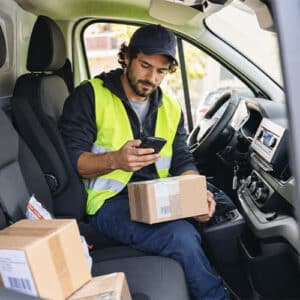 A delivery route may include multiple dozens or even hundreds of stops within residential areas, apartment complexes, shopping centers, and downtown areas. When a delivery driver makes each stop, they may need to back into or out of parking areas, cross sidewalks, open doors to access cargo, and reenter traffic with limited visibility depending on the circumstance. Additionally, larger vehicles such as vans create blind spots for pedestrians, bicyclists, and smaller automobiles.
In Oklahoma, a driver who starts from a stationary location is required by statute to ensure that he/she has sufficient space to complete his/her maneuver without unreasonable danger to himself/herself or others using the roadways. Also, law generally permits reversing on a street or highway only for the distance necessary to enter the proper driving lane from a parked position, and only after the driver has determined that it can be done without endangering other traffic. While a citation can provide valuable evidence in support of a civil claim against a negligent driver, the fact that no citations were issued cannot conclusively establish that there was no negligence involved.
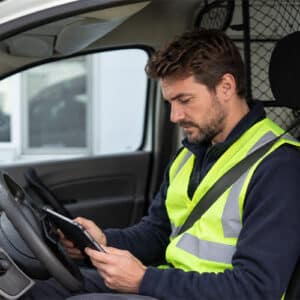
In addition to receiving driving directions, stop locations, customer communications, and delivery details via their telephone or company device(s), investigators need to find out if the driver accessed these devices while operating their vehicle. Additionally, investigators must assess whether the routing plan allowed adequate time to operate their vehicle in a safe manner.
Under Oklahoma law, no driver shall manually compose, send, or read an electronic text message on a handheld device while the vehicle is in motion. Commercial drivers are subject to similar regulations, although those rules are different than those applying to non-commercial drivers. Although navigation systems do not establish negligence per se (i.e., as a matter of law), investigators must compare the driver’s interaction with the navigation system (or other device) with the timing and circumstances surrounding the accident.
Not all delivery vehicles are required to follow the same motor carrier safety regulations. The Federal Motor Carrier Safety Regulations typically apply to commercial motor vehicles that meet applicable regulatory criteria, including but not limited to qualifying vehicles operating in interstate commerce. This includes property-carrying vehicles with a gross vehicle weight, gross vehicle weight rating, gross combination weight, or gross combination weight rating of 10,001 pounds or more, as applicable, as well as certain passenger-carrying and hazardous-material vehicles.
Oklahoma also applies many federal motor-carrier safety standards to qualifying intrastate commercial motor vehicles, subject to state-specific requirements and exceptions. Therefore, which driver-qualification, hours-of-service, maintenance, or recordkeeping provisions apply will depend on factors such as the type of vehicle, its weight or rating, the type of goods being transported, and whether the operation is interstate or intrastate.
Contact us today for your free & confidential case review. Our team will help you get the compensation that you deserve.
Depending on how the crash occurred (speed; distracted driving; failure to yield; careless backup; impaired driving), a driver could have liability for a crash. If the driver was trying to meet their delivery schedule and was involved in a car accident, it will likely not help them with their defense if they were operating at a speed and manner that placed other drivers and pedestrians at risk. The driver’s version of what happened needs to be compared against all possible evidence, including video, vehicle data, app usage history, and witness statements.
If a driver is acting within the scope of employment while delivering goods or packages when he/she causes an automobile accident, the employing party will generally be liable. This can include liability from the business itself for such actions as placing someone behind the wheel who has no qualifications to operate the vehicle safely; for allowing known problems with the operation of a truck or van to remain unresolved; and/or by establishing policies/practices which are directly related to the collision. There are various types of potential claims depending upon what type(s) of evidence exist regarding how the crash happened under Oklahoma law.
Some of these delivery services utilize smaller local Businesses to provide routes, and some utilize “route owners” or independent contractors. While a contract designation of the worker as an independent contractor may affect whether or not the worker is considered to be an employee, the courts consider many factors when determining this classification including but not limited to; who controls the “means and methods” of how the work is performed; who assigns the routes; who provides specific procedures for performing the job; who trains the workers; who monitors performance; how the workers are paid; and finally who has control over the drivers.
While the entity providing the vehicle may not always be the same as the entity providing employment to the driver, there are certainly cases where multiple entities in the supply/delivery chain would share liability for damages arising out of a crash if those additional parties had failed in some way that impacted the ability of the driver to drive safely. Only add entities to your case when you have sufficient evidence supporting a role for each in causing harm.
A repair service/inspector may be held accountable for an accident as well if their inspection, maintenance, or repair negligence resulted in an unsafe braking system contributing to the vehicle crash. The same can be said of a defective brake part causing a failure; an individual injured by such could also have a product liability claim against the manufacturer or other party who sold the defective part.
Useful delivery case evidence is often contained in documentation not listed within the police report. Examples of useful evidence could include:
The vehicle will likely have been repaired, and the digital system utilized by the driver(s) to perform their job will also be changed as they continue with their daily activities. A preservation request that focuses specifically on the vehicle being used for deliveries, route records, app data, communication, and video will assist in identifying what evidence should be preserved.
Delivery companies will frequently claim that the driver was working for another entity, was operating his/her own automobile, had completed the delivery route, or was engaged in a personal errand. The insurers can also make several arguments. Which insurance policy should apply? Was the driver logged onto the app? Was the delivery still active at the time of the incident? Does the treatment sought relate to this incident?
A second most commonly used defense is that the injured party contributed to their injury through some type of negligent act such as driving too fast, passing a stopped van, or failing to respond to an imminent hazard. Pursuant to Title 23, Section 13 and 14, an injured party cannot be denied recovery unless they have been found to be comparatively negligent (i.e., their negligence was worse than the total negligence of all parties) with regard to the accident; if the injured party has been found to be partially at fault, then their damages will be reduced based upon the percentage of comparative fault.
 The recoverable amount depends on the evidence, not the company name on the vehicle.
Economic losses (examples):
Noneconomic losses (examples):
Title 23, Section 61.3 as of September 1, 2025, eliminates the statutory limit on economic loss compensation for bodily injuries occurring on/after that date. The statute limits non-economic compensation to $500,000 but provides different treatment depending upon: the nature of certain permanent severe injuries; qualifying permanent mental injury; specified misconduct; and the findings required by law, so application must be made to each case individually.
Contact us today for your free & confidential case review. Our team will help you get the compensation that you deserve.
For injury to another’s property (Title 12, Section 95) and personal injury claims, the statute of limitations is generally two years. There are no good reasons to delay. It will likely be difficult to obtain information about the name and records of the delivery service months after your collision.
You need to take extra steps when dealing with government vehicles. If you were injured as a result of a crash involving a United States Postal Service driver, it may have been filed under the Federal Tort Claims Act. A Federal Tort Claims Act claim generally must first be presented to the appropriate federal agency within two years after the claim accrues. Standard Form 95 is commonly used for this purpose, although the form itself is not mandatory. If the agency issues a final written denial, a lawsuit generally must be filed within six months after the date the denial is mailed. If the agency does not finally resolve the administrative claim within six months after it is filed, the claimant generally may treat the inaction as a denial and proceed with suit. In addition, if the claim is a claim against the State of Oklahoma or a political subdivision thereof, notice must be given to Oklahoma within one year of the loss, and suit commenced within 180 days of receipt of written denial by Oklahoma. However, exceptions and other claims could shorten the statute of limitations; therefore, you should check the identity of the operator immediately.
A legal advocate may also have particular value if your injuries were severe; you do not know whether the truck driver was on-the-job at the time of the accident; there are multiple companies that will need to be identified as defendants in a lawsuit for their roles in shipping packages; the accident was caused by a U.S. Postal Service or Government owned/leased vehicle; or if the insurance carrier is requiring you to give a fast written account of what occurred or sign a waiver. The attorney can investigate how the driver and delivery operations functioned; issue focused “preservation notice” to preserve relevant evidence; help to determine which laws (statutes) govern your case; help to identify all of the possible sources of available insurance coverage; document your losses; defend against accusations regarding fault; assist in negotiating with the parties responsible for paying compensation; and when necessary, file a lawsuit.
The purpose is not to list all of the companies that had involvement in getting the package delivered. The purpose is to list those individuals/entities who are responsible for creating the circumstances that led to the auto accident and provide each defendant with credible supporting documentation.
Edwards & Patterson Law offers a free and confidential case review. The firm receives payment only if it obtains compensation for a client. Contact us through our online form to speak with a Tulsa delivery truck accident lawyer about your circumstances. Every case depends on its facts, and no result is guaranteed.
No. While a logo could be a good place to start when trying to find out the Company that hired a Driver, owned the vehicle he drove, paid him for his time on the road, and provided liability insurance, these are issues that will need to have been addressed in contracts and records of each of those parties. Evidence from documents related to vehicles and the actual delivery made by the Driver would also be needed. Yes. However, your investigation into this issue should include determining whether the Driver was actively engaged in the process of delivering something; what app or business assigned him the delivery; and what type(s) of auto coverage (personal, commercial, or supplemental) apply. If you were able to obtain information from the Driver’s app regarding his status during the time of the accident and/or trip records, this could help. Not necessarily. Prior to providing them with any additional information, including a complete recorded statement or releasing any claims against them, consult with an attorney as to whom they represent and how your statements may be utilized.Frequently Asked Questions
Does a Company Logo Prove That Company Is Responsible?
What if the Driver Was Using a Personal Car?
Should I Give the Delivery Company’s Insurer a Recorded Statement?
 Call Now918-302-3700
 Send Text539-295-4225








Or fill in the form below with your case details and we will respond to your inquiry within 15 minutes..
"*" indicates required fields
Or fill in the form below with your case details and we will respond to your inquiry within 15 minutes..
"*" indicates required fields
"*" indicates required fields
We will review your quote request within 1-2 business days and will contact you by either phone or email, or both. In the meantime, learn more about your team!

