
If you’re worried that a nursing home has failed your loved one, you probably have more questions than answers right now. This page is meant to give you honest, practical information, not a sales pitch. We’ll explain when you can sue a nursing home for negligence in Oklahoma, why these cases can be difficult, what evidence matters most, and what you should do right now to protect your family’s options.
If your loved one is in immediate danger, call 911 or get them to an emergency room first. Everything else, including calling a lawyer, can wait until they are safe.

Get Your FREE & Confidential Case Review Today!
 Call Now
 Send Text
Loved one Needing a Nursing Home Abuse Lawyer?
Contact us today for your free & confidential case review. Our team will help you get the compensation that you deserve.
Quick Answers
 Can you sue a nursing home for negligence? Yes. Nursing homes owe residents a legal duty of care. When a facility fails to meet that duty and a resident is harmed as a result, the family may have grounds for a negligence lawsuit.
Is it difficult to sue a nursing home? It can be. Medical causation is complicated in older adults; facilities often have layers of corporate ownership, and records can disappear quickly. That said, many of these obstacles are manageable with early action, the right evidence, and an attorney who has handled these cases before.
What should I do today if I suspect neglect? Confirm your loved one is medically stable. Write down what you observed and when. Photograph any visible injuries. Then call an attorney, not because you have to decide anything yet, but because evidence fades fast and you need someone making formal record requests on your behalf.
What Nursing Home Negligence Actually Means
Negligence is not the same as abuse, though the two sometimes overlap. Negligence means a facility or its staff failed to provide the level of care a reasonably competent provider would have given under the same circumstances, and that failure caused harm. It can be a single serious incident, or it can be a slow pattern of inadequate care that builds over weeks or months.
Families usually recognize nursing home negligence when they see it, even if they don’t have a legal term for it. Common examples include:
- Severe dehydration or unexplained weight loss
- Missed medications or medication errors
- Pressure injuries (bedsores) that were preventable or allowed to worsen
- Unexplained falls, especially repeated falls
- Infections tied to poor hygiene or unsafe conditions
- A resident left in soiled clothing or bedding for extended periods
These situations are not simply “bad luck” in an aging population. They are often preventable outcomes that result when facilities cut corners on staffing, skip required care planning steps, or fail to follow basic clinical protocols.
The Legal Basics of a Negligence Claim
To bring a successful nursing home negligence case in Oklahoma, you generally need to establish four things:
- Duty — The nursing home had a legal obligation to care for your loved one.
- Breach — The facility or staff fell short of that obligation in some meaningful way.
- Causation — That failure caused or substantially contributed to your loved one’s injury or decline.
- Damages — There are real, measurable harms as a result, physical, financial, or both.
The duty piece is rarely contested. Once a facility admits a resident, federal regulations and the terms of admission create clear responsibilities.
Federal Expectations That Support the Duty Story
Federal regulations for Medicare- and Medicaid-certified facilities set a floor for the level of care residents can expect. These include:
- The right to be free from abuse, neglect, and exploitation
- Individualized care planning that addresses each resident’s specific needs and is updated as conditions change
- Sufficient nursing staff to meet resident needs around the clock
- Clinical protocols for common, preventable conditions like pressure injuries
When a facility fails to meet these standards, its own required documentation often becomes the most damaging evidence against it. Care plans that weren’t updated, incident reports that were never filed, staffing logs that show a skeleton crew on the night of the injury, these are the records that tell the real story.
Oklahoma-Specific Rights and Liability
Oklahoma law provides direct liability hooks for nursing home cases. Under state statutes, both owners and licensees of nursing facilities can be held responsible for negligent acts committed against residents. Oklahoma law also includes strong protections against retaliation for residents or families who complain or pursue legal action. Importantly, the state’s framework includes clear language about jury trial rights and limits on waivers, which is relevant if you’re worried about paperwork you signed at admission.
Get Your FREE & Confidential Case Review Today!
Loved one Needing a Nursing Home Abuse Lawyer?
Contact us today for your free & confidential case review. Our team will help you get the compensation that you deserve.
Who Can Bring the Case and When
Who Typically Has Standing
If your loved one is still living and capable of making decisions, they can bring the claim themselves or designate a legal representative to act on their behalf. If your loved one has a guardian, conservator, or durable power of attorney in place, that person typically has the authority to pursue the case. If your loved one has passed away as a result of the neglect, a representative of the estate, often a surviving spouse or adult child, may bring a wrongful death claim. We can sort out the right procedural path for your specific family situation during a free consultation.
Time Limits: Act Early
Deadlines in these cases are strict. Oklahoma commonly uses a two-year framework for personal injury and wrongful death claims, but that general rule has exceptions depending on when the harm was discovered, who the defendant is, and other case-specific facts. The safest thing we can tell you is this: do not wait. Evidence disappears, witnesses move on, and memories fade. Call us, and we’ll confirm the correct deadline for your situation. It takes minutes and costs you nothing.
What Evidence Actually Moves a Nursing Home Case Forward
This is where nursing home cases are won or lost. A good outcome depends on building a detailed, documented picture of what the facility knew, what it was required to do, and what it actually did, or failed to do.
 Medical Records and Diagnosis Timeline
 Medical Records and Diagnosis Timeline
The clinical record should show a clear progression, or the absence of one where there should have been intervention. What does the admission assessment say? At what point did the pressure injury first appear, and what was the care response? Were medications documented as administered? A gap in documentation is itself a form of evidence.
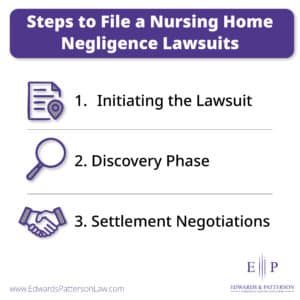
Filing a nursing home negligence lawsuit involves several critical steps, each designed to build a robust case against the offending facility.
From determining the damages to initiating the lawsuit, navigating the discovery phase, and engaging in settlement negotiations, each step requires careful attention and legal expertise.
Facility Records That Matter
- Care plans and care plan updates — Was the plan current? Did it address known risk factors?
- Staffing records — Were there enough nurses and aides on shift to meet resident acuity levels?
- Incident and accident reports — Was the fall documented? Was there a follow-up assessment?
- Wound logs and skin assessment records — Was the pressure injury documented from the start, or did it appear without explanation?
- Medication administration records (MAR) — Were medications given as prescribed?
- Infection control logs — Were there patterns the facility should have acted on?
Photos, Videos, and Witness Accounts
Photographs of injuries with date and time context are among the most persuasive pieces of evidence in these cases. If your loved one has visible wounds, document them immediately. Video from your own phone is admissible. Statements from other families, former residents, or current staff who witnessed conditions can also support your case. Other family members at the same facility often have relevant observations, and many are reluctant to speak until someone reaches out directly.
Public Oversight Evidence: CMS Care Compare
Before or after you contact us, it is worth looking up the facility on CMS Care Compare. This free federal database shows inspection history, staffing levels, and health deficiencies going back several years. A “deficiency” is a finding from a state surveyor that the facility violated a federal care standard. The more deficiencies, especially repeated deficiencies in the same category, the clearer the picture of a facility with systemic problems rather than an isolated mistake.
Complaint investigation findings from the Oklahoma State Department of Health are also public record and can reveal a pattern that predates your loved one’s harm.
What to Do Right Now: Step by Step
Step 1: Confirm Medical Safety
If your loved one has an acute injury, a wound that isn’t healing, signs of infection, severe dehydration, or unexplained mental decline, get them a medical evaluation right away, either through the facility’s physician, a hospital, or an outside doctor you trust. Their health comes first.
Step 2: Document and Preserve Evidence
Write down what you observed and when, while details are still fresh. Photograph any visible injuries. Save copies of any communications you have received from the facility. Do not destroy or remove anything from the resident’s room without guidance from an attorney.
Step 3: Report Through Official Channels
You can file a complaint with the Oklahoma State Department of Health, Long-Term Care Division. They investigate complaints confidentially, and findings are provided in writing. Medicare also directs nursing home condition complaints to the state survey agency. Filing a complaint creates an official record and may trigger an inspection. An attorney can help you understand what the findings mean and how they connect to your legal claim.
Step 4: Contact an Attorney Early
This is not about committing to a lawsuit. It is about making sure records get formally requested before they are altered, lost, or destroyed, which happens more often than you might think. An attorney can also help you ask the right questions of the facility, interpret care records you may not be familiar with, and understand whether what you are seeing rises to the level of a legal claim.
Step 5: Understand What the Lawsuit Process Looks Like
If there is a viable claim, the general process moves through these phases: investigation and evidence gathering, formal filing, discovery (where both sides exchange documents and take depositions), settlement discussions, and trial if needed. Most nursing home cases resolve before trial, but the ones that do go to trial are usually the ones where the facility or its insurer refused to offer reasonable compensation. We prepare every case as if it is going to trial, because that is the only way to have real leverage in settlement negotiations.
Get Your FREE & Confidential Case Review Today!
Loved one Needing a Nursing Home Abuse Lawyer?
Contact us today for your free & confidential case review. Our team will help you get the compensation that you deserve.
Is It Difficult to Sue a Nursing Home?
Honestly, yes, these are not simple cases. Here is why:
Medical Causation Is Complicated in Older Adults
Nursing homes routinely argue that a resident’s condition was a natural consequence of age and existing illness, not negligence. In some cases, that argument has merit. In others, it is a deflection. Separating legitimate clinical deterioration from preventable harm often requires a medical expert who can walk through the records and give an independent opinion. That expert testimony is often central to winning.
Corporate Ownership Layers
Many nursing homes are owned through a web of related corporate entities, a management company, a real estate holding company, an operator, and a staffing company. This structure can make it harder to identify every responsible party and collect on a judgment. An experienced nursing home attorney knows how to trace these relationships and make sure the right parties are named in the case.
Records Access and Documentation Gaps
Facilities control the records. Informal notes disappear. Staff members who witnessed incidents may no longer work there by the time the case develops. Getting formal legal holds on records early, which an attorney can do, is one of the most important steps in preserving your ability to build the case.
Arbitration Clauses in Admission Paperwork
This comes up constantly. Many nursing homes include arbitration clauses in admission contracts. Nationally, this has been a significant barrier to families pursuing their legal rights. Here is what federal rules currently require: arbitration cannot be a condition of admission, there must be a rescission window after signing, and agreements cannot include gag language that limits what residents or families can say publicly. If you signed an arbitration clause at admission, an attorney needs to review it before assuming it is enforceable. Many are not.
What Makes It Less Difficult
Acting early makes a measurable difference. Getting a medical evaluation immediately creates an objective record. Reporting through official channels puts the facility on notice and generates independent documentation. Calling an attorney promptly allows formal preservation of records before they disappear. None of these steps obligates you to file a lawsuit; they simply protect your options while you figure out what you want to do.
What Compensation Can Include
Damages in a nursing home negligence case can include medical expenses related to treating the harm caused by negligence, costs of relocating a resident to a safer facility, compensation for the pain and suffering your loved one endured, and, in cases where the resident has passed away, wrongful death damages including loss of companionship, funeral expenses, and financial losses sustained by the family.
We are not going to quote you a number on this page. The honest answer is that case value depends entirely on the specific facts: the severity of the harm, the strength of the evidence, the defendant’s financial structure, and a dozen other variables. Any firm that tells you otherwise before seeing your records is not being straight with you. What we can tell you is that we take these cases on contingency; you pay nothing unless we recover for you.
Frequently Asked Questions
Can you sue a nursing home for negligence if your loved one has dementia?
Yes. A diagnosis of dementia does not eliminate a nursing home’s duty of care; it actually intensifies it. Residents with cognitive impairment require more monitoring, more careful medication management, and more proactive fall and injury prevention. If anything, a facility that knew about a dementia diagnosis and still failed to provide adequate supervision has a harder time arguing the harm was unavoidable.
Is it difficult to sue a nursing home if you signed admission paperwork?
Signing admission paperwork, including an arbitration agreement, does not automatically waive your right to sue. Federal rules limit how these agreements can be used. Have an attorney review what you signed before assuming your options are limited.
Can you sue for negligence without moving your loved one out of the facility?
Yes, though we understand many families choose to relocate a loved one once legal proceedings begin. You do not have to move them as a condition of pursuing a claim. Your attorney can advise you on whether staying or moving makes more sense given the circumstances.
What if the nursing home says the injury was unavoidable?
That is a common response, and it is not automatically true. Many injuries labeled as “unavoidable” by facilities are found, upon expert review, to have been directly preventable with proper care. The medical and nursing standards around pressure injuries, falls, and infections give experts clear benchmarks for what a reasonably staffed, competent facility should have done.
How long does a nursing home negligence lawsuit take?
Most cases take one to three years from investigation to resolution. The timeline depends on the complexity of the medical evidence, how quickly the facility provides records, whether expert witnesses are needed, and whether the case settles or goes to trial. We keep our clients updated at every stage so there are no surprises.
What evidence should I gather before calling a lawyer?
Write down everything you have observed and when. Photograph any visible injuries. Save any letters, emails, or texts from the facility. That is enough to get started. You do not need to have everything organized before calling us; that is part of what we help with.
About Edwards & Patterson Law
Written by the attorneys at Edwards & Patterson Law, a personal injury firm serving clients in Tulsa, McAlester, and throughout Oklahoma and Arkansas. Attorney Tony Edwards has practiced personal injury law in Oklahoma since 1982 and has handled nursing home cases throughout his career. Attorney Matthew Patterson is admitted to practice in all Oklahoma state courts and federal courts covering Tulsa and McAlester.
This page is for general informational purposes and does not constitute legal advice. Every case is different. Contact us for a free, confidential review of your specific situation.
Primary Sources Referenced
- Oklahoma Statutes — Nursing home owner and licensee liability, resident rights, and retaliation protections
- Electronic Code of Federal Regulations (eCFR), Title 42, Part 483 — Medicare and Medicaid nursing facility conditions of participation
- Centers for Medicare & Medicaid Services (CMS) — Care Compare inspection and deficiency data
- Centers for Disease Control and Prevention (CDC) — Nursing home and long-term care data
- Oklahoma State Department of Health, Long-Term Care Division — Complaint investigation process and findings
Last updated Thursday, March 26th, 2026